The purchase price of a household appliance is only part of what it costs to own.
Washing machines, tumble dryers, dishwashers, fridges, televisions, ovens and smaller electrical appliances all add to your electricity bill — but working out the actual cost of using them can be confusing.
The good news is that you can estimate the running cost of almost any electrical appliance with a simple calculation.
This guide explains how to work out appliance running costs, how to read energy labels and which appliances are worth paying particular attention to.
If you are reviewing appliance costs as part of your wider budget, our guide on how to organise household bills can help you keep regular and variable costs together.
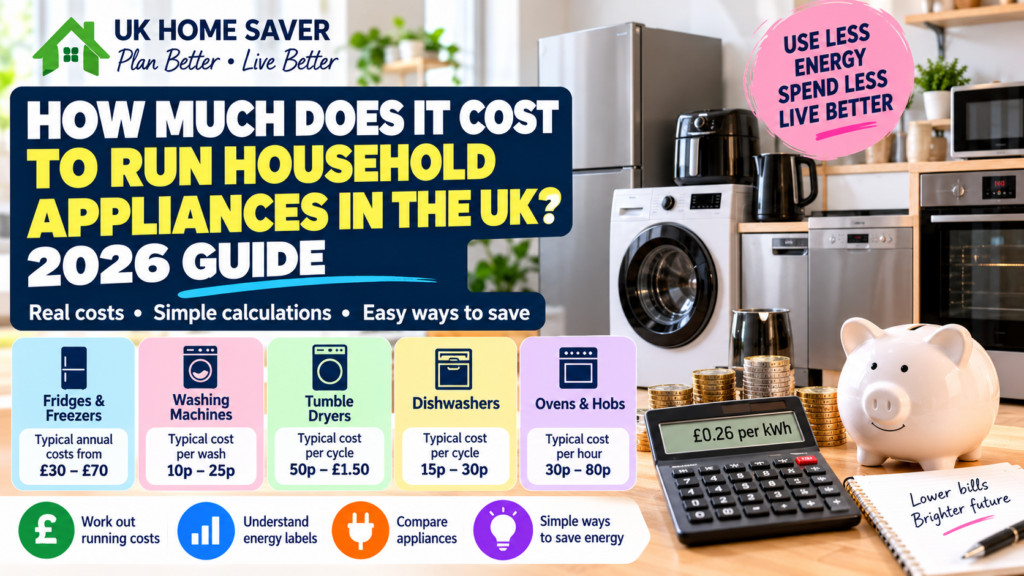
What Electricity Price Should You Use?
For households in England, Scotland and Wales on a standard variable tariff paying by Direct Debit, Ofgem’s average electricity unit rate from 1 October to 31 December 2026 is 26.32p per kWh.
The average electricity standing charge is 54.83p per day.
However, your actual rate can differ depending on:
- Where you live
- Your energy supplier
- Your tariff
- How you pay
- Your meter type
Ofgem’s £1,723 headline price-cap figure is based on typical gas and electricity use. It is not a maximum total bill — households using more energy can still pay more. Ofgem
For the most accurate appliance calculation, use the electricity unit rate shown on your own bill.
Important: the examples in this guide use 26.32p per kWh for illustration. They will not exactly match every household.
Northern Ireland has a different energy-market and tariff-regulation system, so the Ofgem figures used in the examples below do not apply there in the same way. Utility Regulator
What Does kWh Mean?
Electricity suppliers normally charge for energy in kilowatt hours, written as kWh.
One kilowatt hour means using 1,000 watts of power for one hour.
For example:
- A 1,000W appliance running for one hour uses approximately 1 kWh
- A 2,000W appliance running for one hour uses approximately 2 kWh
- A 500W appliance running for two hours uses approximately 1 kWh
The amount of electricity an appliance actually uses can change while it is operating, so simple wattage calculations should usually be treated as estimates.
For appliances with an official energy label, the consumption figure on that label can often give you a better starting point.
How to Calculate the Cost of Running an Appliance
The basic formula is:
Electricity used in kWh × electricity unit rate = running cost
Using the October–December 2026 Ofgem average of 26.32p per kWh:
| Electricity used | Approximate cost |
|---|---|
| 0.1 kWh | 2.6p |
| 0.5 kWh | 13.2p |
| 1 kWh | 26.3p |
| 1.5 kWh | 39.5p |
| 2 kWh | 52.6p |
| 3 kWh | 79.0p |
These figures cover the electricity consumed by the appliance.
They do not add the daily standing charge because that is normally payable whether or not you use a particular appliance.
Example: Electric Heater
Suppose an electric heater is rated at 2 kW.
If it operated continuously at that power for one hour:
2 kWh × 26.32p = 52.64p
So one hour would cost approximately 53p.
If it genuinely consumed 2 kWh each hour for five hours:
5 × 52.64p = £2.63
However, thermostatically controlled heaters may cycle on and off rather than drawing their full rated power continuously.
The actual cost therefore depends on the appliance and how it operates.
Example: Kettle
Suppose your kettle is rated at 3 kW and runs for five minutes.
Five minutes is one-twelfth of an hour.
So:
3 kW × 1/12 hour = 0.25 kWh
At 26.32p per kWh:
0.25 × 26.32p = 6.58p
In this example, boiling the kettle for five minutes would cost roughly 6.6p.
The amount of time needed will depend on the kettle and how much water you boil.
This is why only boiling the water you actually need can help reduce unnecessary energy use. Energy Saving Trust currently estimates that avoiding overfilling a kettle could save around £10 a year in Great Britain. Energy Saving Trust
Use the Energy Label Where Possible
For many larger appliances, you do not need to rely purely on the wattage printed on the back.
UK energy labels provide consumption information that makes appliances easier to compare.
Most relevant appliance labels use an efficiency scale from A to G, with A being the most efficient.
But the most useful figure is often the actual kWh consumption shown on the label. Energy Saving Trust
Different products display consumption differently.
Washing Machines
A washing-machine label shows electricity consumption for 100 Eco 40–60 washes.
Suppose a washing machine showed:
50 kWh per 100 cycles
Divide by 100:
50 ÷ 100 = 0.5 kWh per cycle
At 26.32p per kWh:
0.5 × 26.32p = 13.16p
That would make the electricity cost of the labelled eco cycle approximately 13p per wash.
This is an illustrative calculation — check the label on the specific machine you own or intend to buy.
Dishwashers
Dishwasher energy labels also show consumption per 100 eco cycles.
If a dishwasher displayed:
70 kWh per 100 cycles
then:
70 ÷ 100 = 0.7 kWh per cycle
At 26.32p per kWh:
0.7 × 26.32p = approximately 18.4p per cycle
Again, actual usage can vary with the programme selected.
Energy Saving Trust currently estimates that an A-rated 12-place dishwasher costs around £35 per year to run in Great Britain, compared with around £70 for a comparable G-rated model.
Fridges and Freezers
Fridges and freezers are different because they operate continuously.
Their energy label normally gives annual electricity consumption in kWh per year.
Imagine a fridge-freezer label states:
180 kWh per year
Using 26.32p per kWh:
180 × £0.2632 = £47.38
The estimated annual electricity cost would therefore be approximately £47 at that unit rate.
Energy Saving Trust says fridges and freezers account for around 13% of the average household’s energy bill, partly because they need to operate 24 hours a day. Energy Saving Trust
When comparing models, do not only look at the A–G rating.
A larger appliance can consume more electricity than a smaller appliance with the same efficiency rating, so check the actual annual kWh figure too.
Tumble Dryers
Tumble dryers deserve particular attention because creating heat requires significant energy.
Energy Saving Trust groups washing machines, dishwashers and tumble dryers together as accounting for around 14% of a typical household energy bill. Energy Saving Trust
The exact cost of a tumble-dryer cycle depends heavily on:
- Dryer technology
- Energy efficiency
- Programme selected
- Load size
- How wet the clothes are
- Cycle duration
Heat-pump tumble dryers generally use less electricity than older, less efficient technologies because they reuse heat during the drying process.
Where practical, line drying avoids tumble-dryer electricity use entirely.
Televisions
TV energy labels can show electricity consumption per 1,000 hours.
Suppose a television states:
60 kWh per 1,000 hours
At 26.32p per kWh:
60 × £0.2632 = £15.79
So 1,000 hours of use would cost approximately £15.79 at that electricity rate.
A larger television can still consume more energy than a smaller model even when its efficiency rating looks better.
Energy Saving Trust therefore recommends comparing the actual consumption figure rather than relying only on the rating letter.
Ovens and Hobs
Cooking costs vary substantially depending on:
- Appliance type
- Power rating
- Cooking time
- Temperature
- Amount of food
- Whether several foods are cooked together
Energy Saving Trust notes that fan-assisted ovens can be more efficient because circulating hot air allows food to cook effectively at lower temperatures.
It also notes that oven self-cleaning cycles can be energy intensive because they heat the oven to very high temperatures. Energy Saving Trust
For your own oven, checking the manufacturer’s specification is more reliable than using a generic running-cost estimate.
Which Appliances Use the Most Electricity?
There is no single ranking that applies to every household.
A low-power appliance running continuously can eventually use more electricity than a high-power appliance used for only a few minutes.
However, Energy Saving Trust currently identifies several important household categories:
- Washing machines, dishwashers and tumble dryers
- Fridges and freezers
- TVs, laptops and games consoles
- Lighting
- Ovens, microwaves and kettles
How frequently you use each one matters just as much as its rated power.
How to Calculate Monthly Appliance Costs
Once you know the cost of one use, multiply it by how often you use the appliance.
For example, imagine a cycle costs 20p and you run it five times per week.
Weekly cost:
20p × 5 = £1
Approximate monthly cost:
£1 × 4.33 = £4.33
Approximate annual cost:
£1 × 52 = £52
Using 4.33 weeks for an average month gives a more realistic monthly estimate than simply multiplying a weekly amount by four.
Do Smart Plugs Give Better Figures?
A plug-in electricity monitor or compatible smart plug can sometimes give you a more realistic picture of how much electricity a particular appliance consumes.
However, smart devices themselves may also use a small amount of power.
Energy Saving Trust cautions against assuming that adding smart technology automatically saves energy. Energy Saving Trust
Use monitoring devices to understand consumption rather than assuming the device itself creates savings.
Easy Ways to Reduce Appliance Energy Use
You do not necessarily need to replace appliances to reduce electricity use.
Simple habits can include:
- Run washing machines with full loads where practical
- Use lower-temperature programmes where suitable
- Use dishwasher eco settings
- Wait for a full dishwasher load
- Avoid boiling more water than needed
- Line dry clothes when practical
- Avoid unnecessarily over-drying clothes
- Switch devices off when they do not need to remain on
- Check appliance settings and energy-saving modes
Energy Saving Trust estimates that doing one fewer washing-machine load each week and washing at 30°C can save around £27 a year in Great Britain, while reducing dishwasher use by one run a week can save around £10.
Actual savings will depend on the appliance, tariff and household behaviour.
Should You Replace an Old Appliance Just to Save Electricity?
Not automatically.
A new appliance may use less electricity, but buying it also costs money.
If your existing appliance still works reliably, compare:
- Current estimated annual running cost
- New appliance purchase price
- Expected running cost of the replacement
- Repair costs
- Expected remaining lifespan
- Features you actually need
For example, saving £30 per year on electricity would not by itself recover a £600 purchase price quickly.
Energy efficiency is an important factor when an appliance genuinely needs replacing, but it should be considered alongside the purchase cost.
If you are planning for appliance replacement or other irregular household expenses, see our guide to working out the monthly cost of annual bills.
Check Appliance Size as Well as Efficiency
Bigger is not always better.
Energy Saving Trust points out that larger appliances often consume more electricity even when they have the same energy-efficiency rating as smaller ones. Energy Saving Trust
When buying a fridge, freezer, dishwasher or washing machine, choose a capacity that makes sense for your household rather than automatically choosing the largest model available.
Keep Running Costs in Perspective
Appliance calculations are useful, but avoid spending hours worrying about a device that costs only a few pounds per year.
Start with:
- Appliances that produce heat
- Appliances used frequently
- Appliances running continuously
- Older appliances
- Large appliances
Those are more likely to provide useful opportunities for reducing consumption.
It can also help to review these costs alongside your other household bills and recurring payments so you can see their effect on your overall monthly budget.
Optional UK Home Saver Tool
If you want to keep your energy usage alongside your other household costs, the UK Home Saver Household Bills Command Centre includes an Energy Deep Dive alongside bill tracking, subscriptions, everyday spending and savings.
View the Household Bills Command Centre on Gumroad
Also available from the UKHomeSaver Etsy shop.
This is an optional UK Home Saver digital product. You can use every calculation in this guide without purchasing it.
Frequently Asked Questions
How do I calculate how much an appliance costs to run?
Multiply the electricity used in kWh by your electricity unit rate.
If an appliance uses 1 kWh and your tariff is 26.32p per kWh, the electricity cost is approximately 26.32p.
How do I convert watts into kWh?
Divide watts by 1,000 to convert them into kilowatts, then multiply by the number of hours used.
For example:
2,000W ÷ 1,000 = 2kW
Running for one hour would use approximately 2 kWh if it continuously drew its full rated power.
What electricity rate should I use?
Use the unit price from your own electricity bill.
Ofgem’s average Direct Debit electricity rate for standard variable tariffs in Great Britain is 26.32p per kWh from 1 October to 31 December 2026, but individual tariffs vary. Ofgem
Does the standing charge affect appliance running costs?
Your electricity standing charge forms part of your overall bill, but it is normally payable regardless of whether a particular appliance is used.
For comparing the additional cost of running an appliance, the unit rate is usually the relevant figure.
Is an A-rated appliance always cheapest to run?
Not necessarily.
Energy rating is important, but appliance size and actual consumption matter too.
Compare the kWh figure shown on the energy label between similar appliances.
Will appliance running costs change in 2027?
They can.
Ofgem updates the Great Britain energy price cap every three months, and the next cap covering 1 January to 31 March 2027 is due to be announced by 25 November 2026. Ofgem
That means calculations using October–December 2026 electricity prices should be updated when unit rates change.
Final Checklist
To work out what an appliance costs to run:
- Find your electricity unit rate
- Check the appliance wattage or energy label
- Convert consumption into kWh
- Multiply the kWh by your unit rate
- Multiply by how often you use the appliance
- Compare annual as well as daily costs
- Check actual kWh consumption when buying a replacement
- Remember that your tariff can change
Understanding appliance running costs does not mean you need to stop using everyday equipment.
The aim is to identify where electricity is actually being used so you can concentrate on changes that make a meaningful difference to your household bills.
Leave a Comment