Keeping household bills organised can become difficult when payments leave your account on different dates, some costs change from month to month, and annual expenses only appear once or twice a year.
Rent or mortgage payments, Council Tax, energy, broadband, insurance, subscriptions and other household costs can quickly become difficult to track if the information is spread across emails, bank statements and different provider accounts.
A simple household bills system can help you see what is due, what has already been paid, what needs to be saved for later and how much money is still available after your commitments.
This guide explains a practical way to organise household bills in the UK without making your budget unnecessarily complicated.
1. Make a Complete List of Your Household Bills
Start by writing down every household bill you currently pay.
Checking your bank statements, Direct Debits and recent bills can help you avoid missing anything.
Common household bills can include:
- Rent or mortgage
- Council Tax
- Gas and electricity
- Water
- Broadband
- Mobile phone contracts
- TV Licence
- Home insurance
- Car insurance
- Vehicle tax
- Boiler or home emergency cover
- Childcare or school costs
- Pet insurance or vet plans
- Subscriptions and memberships
- Loan or finance payments where applicable
Include costs even if they are not paid every month.
The aim is to create one complete list of the regular expenses your household is responsible for.
2. Separate Monthly Bills From Annual and Irregular Costs
Monthly bills are usually easier to remember because they appear regularly.
Annual and irregular costs are easier to overlook.
For example, you might pay:
- Car insurance once a year
- Home insurance annually
- Vehicle servicing at irregular intervals
- Annual subscriptions
- Membership fees
- Appliance servicing
- Other renewal costs
These expenses still form part of your normal household spending even though they do not leave your bank account every month.
A useful approach is to convert annual costs into monthly amounts.
For example:
£240 annual bill ÷ 12 = £20 per month
If practical, setting aside £20 each month can make the eventual £240 payment easier to manage.
This also gives you a more realistic picture of your true monthly household costs.
3. Record the Amount and Due Date
For every bill, record both the expected amount and when it is due.
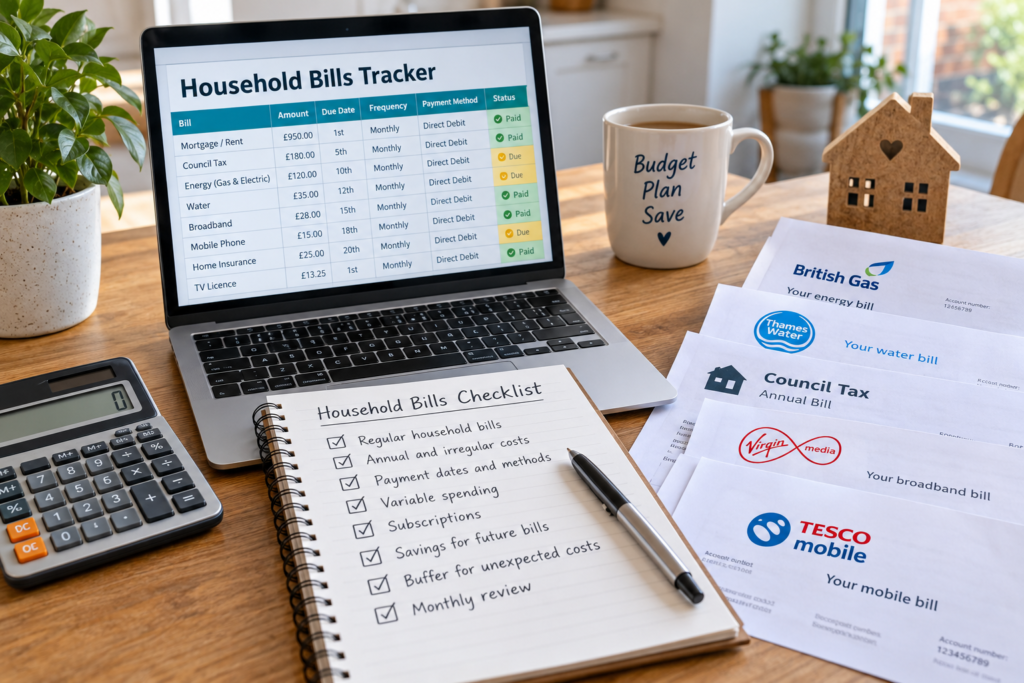
A useful household bills list might include:
- Bill name
- Amount
- Due date
- Payment frequency
- Payment method
- Whether it has been paid
- Renewal date where relevant
Knowing that a bill costs £80 is helpful.
Knowing that the £80 will leave your account on the 12th of the month is even more useful.
Due dates can help you plan around when income arrives and reduce the chance of forgetting a manual payment.
4. Record How Each Bill Is Paid
Household bills can be paid in several different ways.
These might include:
- Direct Debit
- Standing order
- Debit or credit card
- Manual bank transfer
- Online payment
- Annual payment
It is particularly useful to identify bills that require manual action.
A Direct Debit will normally be collected automatically, while a manual payment may be easier to miss.
You can also note which account each payment comes from if your household uses more than one bank account.
5. Separate Fixed and Variable Costs
Some household bills stay broadly the same each month.
Others change.
Examples of relatively fixed costs may include:
- Rent or mortgage
- Broadband
- Mobile phone contracts
- Insurance instalments
- Memberships
Variable costs may include:
- Gas and electricity
- Groceries
- Fuel
- Transport
- Household shopping
- Entertainment
For variable spending, it can be useful to record two figures:
Planned amount — what you expect to spend.
Actual amount — what you really spent.
Comparing the two can help you see where your estimates are realistic and where your household budget may need adjusting.
6. Keep Track of Subscriptions
Small recurring payments can add up.
Make a separate list of subscriptions such as:
- Streaming services
- Music subscriptions
- Cloud storage
- Software
- Apps
- Gym memberships
- Meal plans
- Clubs and memberships
Record:
- Cost
- Billing frequency
- Renewal date
- Payment method
Review the list regularly.
If you no longer use a service, cancelling it can reduce unnecessary recurring spending.
It is also worth checking whether a subscription renews monthly or annually because annual renewals can be easier to forget.
7. Plan for Annual Bills Before They Arrive
An annual bill should ideally not come as a complete surprise.
Suppose your car insurance is expected to cost £600 next year.
Dividing that amount by 12 gives:
£600 ÷ 12 = £50 per month
If your circumstances allow, setting aside £50 per month means you are gradually preparing for the next renewal.
You can use the same approach for other predictable costs such as:
- Home insurance
- Vehicle servicing
- Annual memberships
- Appliance maintenance
- Annual subscriptions
You do not need a complicated system.
Even simply recording the monthly equivalent can make your household budget more realistic.
8. Check Your Energy Costs Regularly
Energy costs can vary throughout the year.
Winter usage may be very different from summer usage, so relying only on one month’s spending can give a misleading picture.
It can help to record:
- Electricity usage
- Gas usage
- Meter readings
- Amount paid
- Tariff information
- Any changes to your regular payment
Your supplier’s statement or online account should contain the most relevant information for your household.
If you use estimates in your own spreadsheet, update them when your actual bill or tariff changes.
9. Keep a Small Buffer for Unexpected Costs
Even a well-organised household plan cannot predict every expense.
If possible, leave some room in your monthly budget for unexpected costs.
Examples might include:
- A higher-than-expected utility bill
- Car repairs
- Home repairs
- Replacement appliances
- Unexpected school costs
- Price increases
The right amount will be different for every household.
The purpose of a buffer is simply to avoid planning every pound as though nothing unexpected will happen.
10. Build a Simple Monthly Bills Routine
A regular routine is often more useful than an overly complicated spreadsheet that you stop updating.
At the start of each month:
- Check which bills are due
- Confirm expected income
- Review upcoming annual payments
- Check subscriptions due to renew
- Set aside money for known commitments
During the month:
- Mark bills as paid
- Update variable spending
- Record unexpected costs
- Note any price changes
At the end of the month:
- Review what you actually spent
- Check what is still outstanding
- Update next month’s plan
Once the routine becomes familiar, it should only take a short amount of time.
11. Review Bills Before Renewals
Renewal dates are useful opportunities to review household costs.
Before a contract or policy renews, check:
- The new price
- Whether the service still suits your needs
- Whether the level of cover is appropriate
- Whether there are alternative options available
- Whether you still need the service at all
Do not assume that every household bill must stay exactly as it is year after year.
Regular reviews can help keep your records accurate and identify costs that deserve attention.
12. Keep Everything in One Place
You can organise household bills using:
- A notebook
- A calendar
- A basic spreadsheet
- A budgeting app
- A dedicated household bills tracker
The best method is usually the one you are comfortable updating consistently.
Keeping everything together makes it easier to answer simple questions such as:
- What bills are due this month?
- What has already been paid?
- Which annual bills are approaching?
- How much is reserved for future payments?
- Which subscriptions are active?
- What money is genuinely available after planned commitments?
A Simple Way to Keep Your Household Bills Together
If you prefer a ready-made spreadsheet, the UK Home Saver Household Bills Command Centre 2026 brings regular bills, annual costs, subscriptions, energy, everyday spending and savings into one connected workbook.
It includes a monthly bills tracker, safe-to-spend dashboard, subscription calendar, energy tracking, savings goals and annual summary.
View the Household Bills Command Centre 2026 on Gumroad
Also available from the UKHomeSaver Etsy shop.
This is an optional UK Home Saver digital product. You can follow all of the steps in this guide without purchasing it.
Frequently Asked Questions
What is the easiest way to organise household bills?
Start with one complete list showing each bill, its amount, due date and payment method. Add annual and irregular costs as well as monthly payments.
How often should I review my household bills?
A brief review each month can help keep your records accurate. It is also worth reviewing individual bills when contracts or insurance policies approach renewal.
Should annual bills be included in a monthly budget?
They can be. Dividing predictable annual costs by 12 can show their approximate monthly impact and help you plan for future payments.
How can I avoid forgetting annual subscriptions?
Record the renewal date alongside the cost and consider adding a calendar reminder before the renewal date.
Should I use a spreadsheet or budgeting app?
Either can work. Choose a system that gives you the information you need and that you are likely to keep updated.
Final Household Bills Checklist
Before you finish setting up your household bills system, check that you have:
- Listed all regular bills
- Included annual and irregular costs
- Recorded payment amounts
- Added due dates
- Recorded payment methods
- Identified variable expenses
- Listed subscriptions
- Added renewal dates
- Planned for annual costs
- Allowed some room for unexpected expenses
- Chosen a regular time to review everything
Organising household bills does not need to mean tracking every penny or building a complicated budget.
A clear list, realistic figures and a consistent monthly routine can make it much easier to understand what is due, what has been paid and what needs to be planned for next.
[…] you are reviewing appliance costs as part of your wider budget, our guide on how to organise household bills can help you keep regular and variable costs […]