Monthly bills are usually easy to spot. Rent or mortgage payments, broadband, Council Tax and mobile contracts regularly appear in your bank account.
Annual and irregular bills are different.
Car insurance, home insurance, servicing, memberships and other costs might only appear once or twice a year. Because they are not leaving your account every month, it is easy to forget about them when working out how much your household really costs to run.
One simple solution is to convert these expenses into a monthly amount.
Doing this can give you a more realistic view of your household spending and help you prepare for larger bills before they arrive.
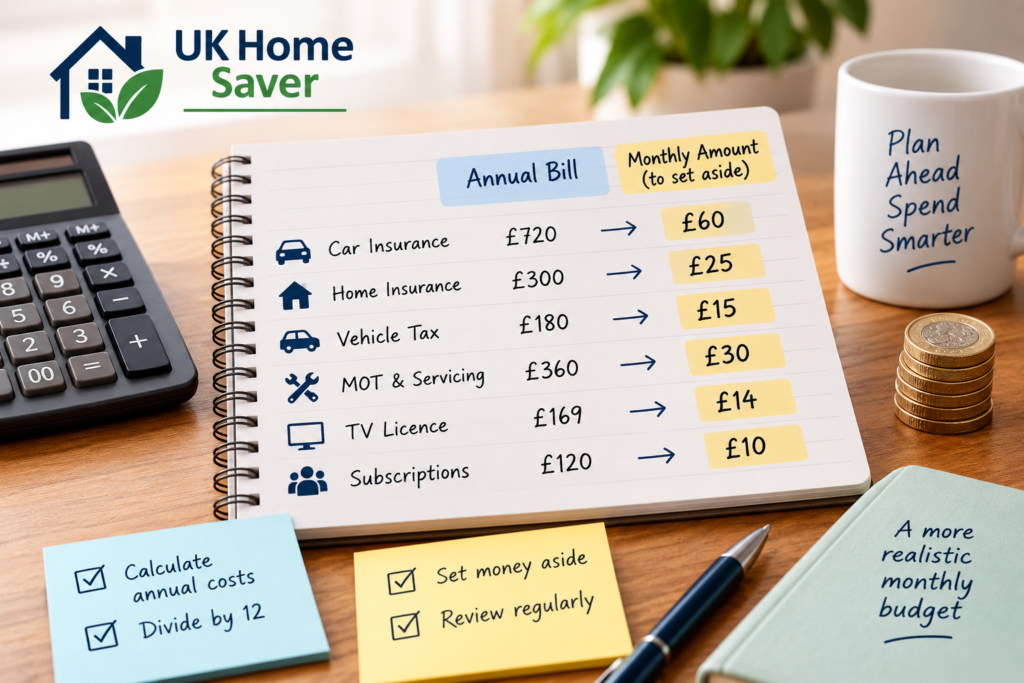
Why Annual Bills Can Make a Monthly Budget Misleading
Imagine your regular household bills total £1,700 per month.
At first glance, you might assume that £1,700 represents most of your essential household spending.
But perhaps you also pay:
- £600 per year for car insurance
- £300 per year for home insurance
- £360 per year for vehicle servicing and MOT costs
- £120 per year for subscriptions
- £180 per year for another annual household expense
Together, those costs total £1,560 per year.
Divide that by 12 and they represent another £130 per month.
Your real average monthly household cost would therefore be closer to £1,830 rather than £1,700.
The bills may not leave your account every month, but the cost still exists.
How to Convert an Annual Bill Into a Monthly Cost
The calculation is straightforward:
Annual cost ÷ 12 = monthly amount
For example:
| Annual bill | Monthly equivalent |
|---|---|
| £120 | £10 |
| £240 | £20 |
| £360 | £30 |
| £600 | £50 |
| £900 | £75 |
| £1,200 | £100 |
If your car insurance costs £720 for the year:
£720 ÷ 12 = £60 per month
You could therefore treat £60 as part of your monthly household budget, even if the insurer takes the full £720 once a year.
What About Bills Paid Every Six Months?
The same principle still works.
Suppose you pay £180 every six months.
That means the yearly cost is:
£180 × 2 = £360
Then:
£360 ÷ 12 = £30 per month
Setting aside £30 each month would build up enough to cover the expected payments over a full year.
What About Quarterly Bills?
If a bill costs £90 every three months:
£90 × 4 = £360 per year
Then:
£360 ÷ 12 = £30 per month
Working everything back to a yearly total first makes different payment schedules much easier to compare.
Which Annual Household Costs Should You Include?
Every household is different, but there are several costs that are commonly paid annually or irregularly.
These might include:
- Car insurance
- Home insurance
- Vehicle tax
- MOT
- Car servicing
- Boiler servicing
- Home emergency cover
- Annual memberships
- Software or app subscriptions
- Professional memberships
- Pet-related plans
- Appliance servicing
- School or activity costs
- Holiday-related annual expenses
- Annual TV or entertainment subscriptions
Go through your bank statements and calendar from the previous 12 months if you are unsure.
You may find expenses you had forgotten about.
Create an Annual Bills List
A useful next step is to make a simple list containing:
- Name of the bill
- Expected annual cost
- Renewal or payment date
- Monthly equivalent
- Amount already saved
For example:
| Bill | Annual cost | Monthly amount |
|---|---|---|
| Car insurance | £600 | £50 |
| Home insurance | £300 | £25 |
| MOT and servicing | £360 | £30 |
| Annual subscriptions | £120 | £10 |
| Boiler service | £180 | £15 |
| Total | £1,560 | £130 |
In this example, the household would ideally account for around £130 per month for these future costs.
That does not necessarily mean every household can immediately save the full amount. The calculation simply shows the average monthly cost of those annual commitments.
Read:How to Organise Household Bills: A Practical UK Checklist
Build an Annual Bills Reserve
Once you know the monthly equivalent, you can consider putting that money aside.
Some banks allow you to create separate savings pots or spaces within an account.
For example, you might have a pot called:
Annual Bills
Each month, you transfer the amount you have calculated into that pot.
When an annual bill arrives, the money is already partly or fully available.
This is sometimes called a sinking fund: money gradually set aside for a known future expense.
You do not need to use that terminology or have a complicated budgeting system. The important idea is simply to recognise future costs before they become due.
Start With the Next Payment Date
Dividing a bill by 12 works well when you are planning for a complete year.
But what if the bill is due sooner?
Imagine your annual car insurance will cost around £600 and is due in six months.
You currently have nothing saved.
Rather than saving £50 per month, you would need:
£600 ÷ 6 = £100 per month
After the payment has been made, you could then start putting aside £50 per month for the following year’s renewal.
This is why recording the actual due date alongside the annual cost is useful.
Do Not Double Count Monthly Bills
Be careful not to include the same bill twice.
Suppose you pay home insurance monthly at £25.
That £25 is already included in your normal monthly bills.
You should not also take the £300 annual equivalent and add another £25 to your annual-bills reserve.
Annual-cost calculations are most useful for expenses that are:
- Paid once a year
- Paid every six months
- Paid quarterly
- Irregular but predictable
Remember That Renewal Prices Can Change
An annual bill this year may not cost the same next year.
Insurance premiums can change. Subscription prices may increase. Servicing costs can vary.
Treat your monthly figure as an estimate rather than a guarantee.
When you receive a renewal notice or updated price, change the amount in your household plan.
For example, if car insurance rises from £600 to £720:
Old monthly amount:
£600 ÷ 12 = £50
New monthly amount:
£720 ÷ 12 = £60
Your monthly reserve would need to increase by £10 if you wanted to fully account for the new annual price.
Include Irregular Costs That Are Not Strictly “Bills”
Some household expenses are predictable even though there is no formal bill.
For example:
- MOT and servicing
- School uniform
- Christmas spending
- Appliance maintenance
- Garden maintenance
- Regular pet costs
- Professional fees
If an expense happens most years, it may be worth including it in your planning.
You can estimate the annual amount based on what you spent previously and adjust it over time.
Why Monthly Equivalents Are Useful
Converting annual costs into monthly figures can make it easier to compare different expenses.
For example, a £480 annual subscription may sound very different from £40 per month, even though they are the same cost.
Looking at the monthly equivalent helps you understand how much of your income is effectively committed to future expenses.
It can also make comparison shopping easier.
If one provider charges £720 annually and another charges £60 per month, both cost £720 over a year before considering any other differences or fees.
Review Your Annual Bills Regularly
It is worth reviewing your list several times a year.
Check:
- Which bills are approaching renewal
- Whether prices have changed
- Whether you still need each subscription or service
- Whether your monthly reserve is sufficient
- Whether a new annual cost has appeared
Renewal dates are also a useful reminder to compare options where appropriate rather than automatically accepting a new price.
Keep Annual and Monthly Bills Together
One of the easiest ways to lose track of annual costs is to keep them completely separate from your normal household budget.
Your monthly plan should ideally show both:
Bills leaving your account this month
and
Money being reserved for future bills
This gives you a clearer picture of how much money is genuinely available after known household commitments.
A Simple Way to Keep Everything Together
You can manage annual costs with a notebook, calendar or basic spreadsheet.
If you prefer a ready-made system, the UK Home Saver Household Bills Command Centre 2026 brings regular bills, annual costs, subscriptions, energy, everyday spending and savings into one connected workbook.
It includes tools for tracking upcoming household commitments and seeing what money is still reserved before you spend.
View the Household Bills Command Centre 2026 on Gumroad
Also available from the UKHomeSaver Etsy shop.
This is an optional UK Home Saver digital product. You can follow all of the methods in this guide without purchasing it.
Frequently Asked Questions
How do I calculate the monthly cost of an annual bill?
Divide the annual cost by 12.
For example, a £480 annual bill is equivalent to:
£480 ÷ 12 = £40 per month
Should I actually save the monthly amount?
If your circumstances allow, setting money aside can make the eventual payment easier to manage. The amount you save will depend on your household finances and when the bill is due.
What if the annual bill is due in less than 12 months?
Divide the amount you expect to pay by the number of months remaining.
For example, if a £600 bill is due in six months:
£600 ÷ 6 = £100 per month
Should monthly Direct Debits be included?
Include them in your normal monthly bills rather than counting them again as annual costs.
What if I do not know exactly how much the next bill will be?
Use a reasonable estimate based on the previous cost and update it when you receive the new price or renewal notice.
Final Checklist
Before finishing your annual-bills plan:
- List annual and irregular household expenses
- Record the expected yearly amount
- Write down when each payment is due
- Divide annual costs by 12
- Adjust the calculation if a payment is due sooner
- Consider putting the monthly amount aside
- Avoid counting monthly bills twice
- Update costs when renewal prices change
- Review the list regularly
Annual bills do not have to be unexpected bills.
By converting them into monthly amounts and including them in your normal household planning, you can get a much clearer view of what it really costs to run your household.
Leave a Comment