Updated: 30 October 2026
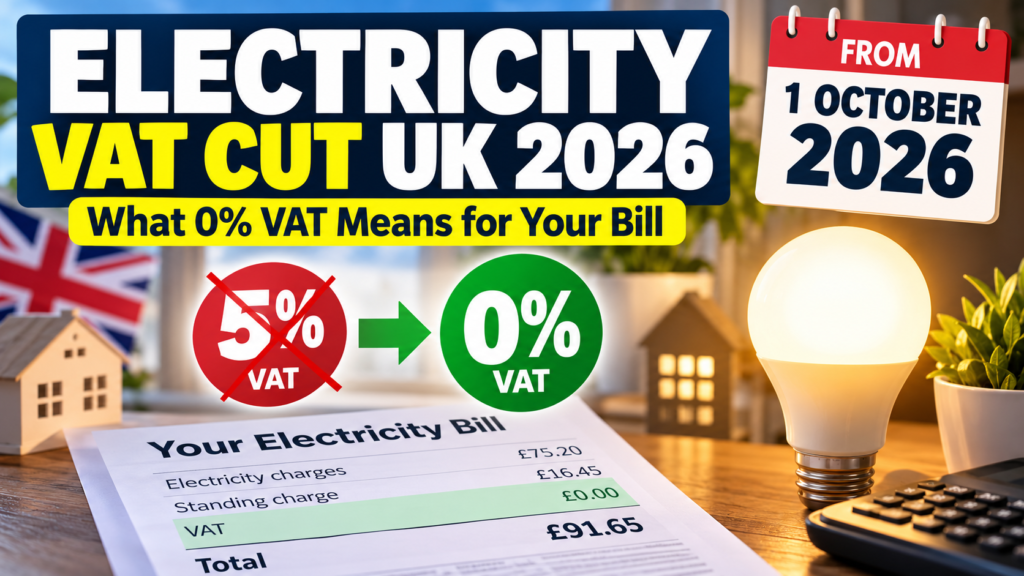
Household electricity bills changed across Great Britain on 1 October 2026 after VAT on qualifying domestic electricity was temporarily reduced from 5% to 0%.
The change applies in England, Scotland and Wales from 1 October 2026 to 1 July 2027. Northern Ireland is different: qualifying domestic electricity there continues to be charged at the reduced 5% VAT rate.
The UK Government estimates that removing VAT from household electricity will save a typical household around £45 a year. The exact saving depends on how much electricity you use and the tariff you are on.
However, there is an important point to understand: removing VAT does not guarantee that your total energy bill will fall. Electricity and gas unit rates, standing charges, weather and household usage all affect the final amount you pay.
This guide explains what changed, who benefits, how the current Ofgem price cap fits in, what happens on fixed tariffs and prepayment meters, and what to check on your electricity bill.
What Changed on 1 October 2026?
Before 1 October 2026, qualifying domestic electricity in Great Britain was normally charged at a reduced VAT rate of 5%.
For the period from 1 October 2026 to 1 July 2027, that VAT rate has been temporarily reduced to 0%.
You do not need to apply for the change. Your electricity supplier should apply the new VAT treatment automatically to qualifying domestic electricity supplied during the zero-rate period.
Where Does the 0% VAT Rate Apply?
The temporary 0% rate applies to qualifying domestic electricity in:
- England
- Scotland
- Wales
It does not apply in the same way in Northern Ireland. Qualifying domestic electricity in Northern Ireland continues to carry 5% VAT.
This distinction matters because national headlines may simply say that VAT has been removed from electricity bills, while the legal measure specifically applies to Great Britain.
How Long Will the Electricity VAT Cut Last?
The current temporary zero rate runs from:
1 October 2026 to 1 July 2027.
Households should not assume the 0% rate will continue beyond that date unless the government announces an extension or a new policy.
How Much Could a Household Save?
The government estimates an average saving of around £45 per year.
This is an average estimate rather than a guaranteed amount. Your own saving will depend mainly on:
- How much electricity you use
- Your electricity unit rate
- Your standing charge
- Your tariff type
- Your payment method
- Whether your home relies heavily on electricity for heating or hot water
A household using more electricity may save more in cash terms than a very low-usage household.
A Simple Example
Imagine that an electricity charge before VAT would have been £800.
Under the old 5% VAT rate:
£800 × 5% = £40 VAT
The total would have been:
£840
At 0% VAT, that £40 VAT charge would not be added, so the same pre-VAT electricity charge would remain £800.
This example is deliberately simple. Real energy bills can also change because unit rates, standing charges and consumption change.
What Is the Current Ofgem Price Cap?
For the period from 1 October to 31 December 2026, Ofgem’s energy price cap is equivalent to around £1,723 per year for a typical dual-fuel household paying by Direct Debit in England, Scotland and Wales.
That headline figure is not a maximum bill. It is based on typical energy consumption.
If you use more energy, you can pay more than £1,723. If you use less, you can pay less.
Current Average Electricity Rates
For a typical household on a standard variable tariff paying by Direct Debit, Ofgem gives the following average electricity figures for 1 October to 31 December 2026:
- Electricity unit rate: 26.32p per kWh
- Electricity standing charge: 54.83p per day
These are averages across England, Scotland and Wales. Your actual rates can differ depending on your region, supplier, meter and payment method.
Do Not Deduct Another 5%
The current Ofgem electricity figures already reflect the temporary removal of VAT on electricity.
That means you should not take the published 26.32p per kWh figure and subtract another 5%. Doing that would count the VAT reduction twice.
What About Gas?
The temporary zero rate applies to qualifying domestic electricity in Great Britain. Domestic gas continues to carry 5% VAT.
For 1 October to 31 December 2026, Ofgem gives average Direct Debit gas rates of:
- Gas unit rate: 7.97p per kWh
- Gas standing charge: 29.68p per day
These gas figures include 5% VAT.
Why Can Your Total Energy Bill Still Rise?
The removal of electricity VAT affects only one part of your energy costs.
Your total bill can still rise because of:
- Higher gas or electricity wholesale costs
- Changes to Ofgem’s price cap
- Higher winter energy use
- Changes in standing charges
- A fixed tariff ending
- Moving onto a different tariff
This is why a household can benefit from the VAT reduction and still pay more overall than it did during a warmer or cheaper period.
Does the VAT Cut Apply to Fixed Tariffs?
The government says the VAT removal also applies where households have already fixed their energy tariff.
That does not necessarily mean the headline tariff rate shown when you first signed the contract will visibly change in the way you expect. Suppliers must apply the correct VAT treatment to qualifying electricity during the zero-rate period.
If you are unsure how your supplier has applied the change, check your bill or contact the supplier directly.
Does It Apply to Prepayment Meters?
Yes, qualifying domestic electricity used through prepayment arrangements in Great Britain is also covered by the temporary 0% VAT rate.
Before the change, VAT was built into electricity top-ups. From 1 October 2026, qualifying electricity top-ups should reflect the temporary zero rate.
Do You Need to Apply?
No. There is no normal application process for the electricity VAT reduction.
Your supplier should apply it automatically.
You should not need to:
- Complete a government application form
- Pay a fee
- Give someone your online banking password
- Provide security codes sent by your bank
Be cautious if someone contacts you unexpectedly and claims you must provide financial information to receive the VAT saving.
How to Check Your Electricity Bill
Look at the electricity section of your bill rather than just the total amount due.
Check:
- The billing dates
- The electricity unit rate
- The electricity standing charge
- The number of kWh used
- Any VAT line or VAT summary
If your bill covers both dates before and after 1 October 2026, the supplier may need to treat different parts of the billing period differently.
What If Your Bill Still Shows 5% VAT on Electricity?
First check the dates covered by the bill.
If part of the electricity was supplied before 1 October 2026, that earlier period may still be subject to the previous VAT treatment.
If your bill covers electricity supplied entirely within the zero-rate period in Great Britain and appears to charge 5% VAT on that electricity, contact your supplier and ask for an explanation.
Electricity-Heavy Homes May See a Bigger Cash Saving
The VAT cut may be more noticeable for households that use a higher proportion of electricity.
Examples can include homes using:
- Electric heating
- Storage heaters
- Electric hot-water systems
- Heat pumps
- Electric cooking
- Electric vehicles
However, higher electricity use still means a higher underlying bill, even when VAT is reduced.
The VAT Cut and Warm Home Discount Are Different
The electricity VAT reduction is separate from the Warm Home Discount.
The Warm Home Discount provides eligible households with a separate £150 energy-bill discount.
For the current scheme rules, see our Warm Home Discount October 2026 guide.
Where a household meets the Warm Home Discount eligibility rules, it can benefit from both measures because they are separate forms of support.
Do Not Treat the £45 Estimate as Cash Income
The government’s £45 figure is an estimate of the average reduction in electricity costs. It is not normally a separate £45 cash payment into your bank account.
When budgeting, avoid counting the saving twice by adding £45 to income and also reducing the electricity estimate by £45.
Use Annual Costs to Get a Clearer Household Budget
Energy costs vary through the year, especially between summer and winter.
Looking only at one month’s bill can therefore give a misleading picture of what your household really costs to run.
A useful approach is to estimate annual costs and convert them into monthly equivalents.
Our live guide on how to work out the true monthly cost of annual bills explains the method step by step.
Should You Switch Energy Tariff Because of the VAT Cut?
The VAT change alone is not a reason to switch.
When comparing energy tariffs, look at the full deal, including:
- Electricity unit rate
- Gas unit rate
- Standing charges
- Exit fees
- Contract length
- Whether the tariff is fixed or variable
- Your own expected annual usage
A tariff with a lower-looking unit rate can still cost more overall if another part of the deal is less favourable.
Optional UK Home Saver Tool
If you prefer to track electricity, gas and other household costs together, the UK Home Saver Household Bills Command Centre is an optional spreadsheet system for organising bills, annual expenses, subscriptions, energy use and savings.
You do not need to purchase anything to follow the information in this article.
Electricity VAT Cut 2026: Key Facts
| Item | Current position |
|---|---|
| Domestic electricity VAT in Great Britain | 0% from 1 October 2026 to 1 july 2027 |
| Northern Ireland domestic electricity VAT | Remains 5% |
| Estimated average saving | About £45 per year |
| Ofgem cap, Oct-Dec 2026 | £1,723 for a typical dual-fuel Direct Debit household |
| Average electricity unit rate | 26.32p per kWh |
| Average electricity standing charge | 54.83p per day |
| Average gas unit rate | 7.97p per kWh |
| Average gas standing charge | 29.68p per day |
| Application required? | No |
Frequently Asked Questions
Has VAT been removed from household electricity?
Yes, temporarily for qualifying domestic electricity in England, Scotland and Wales from 1 October 2026 to 1 july 2027.
Does the 0% rate apply in Northern Ireland?
No. Qualifying domestic electricity in Northern Ireland continues to be charged at 5% VAT.
How much could the VAT cut save?
The government estimates an average household saving of around £45 per year, although the actual amount depends on electricity usage and tariff prices.
Do I need to apply?
No. Suppliers should apply the correct VAT treatment automatically.
Does the VAT cut apply to fixed tariffs?
Yes. The government says the change also applies to qualifying household electricity on fixed tariffs.
Does it apply to prepayment customers?
Yes, qualifying domestic electricity supplied through prepayment arrangements in Great Britain is included.
Why might my energy bill still go up?
The VAT reduction affects only electricity tax. Your overall bill also depends on unit rates, standing charges, gas prices, weather and how much energy you use.
Is £1,723 the maximum I can pay?
No. The headline Ofgem price-cap figure is based on typical usage. Your actual bill depends on your own consumption and tariff.
Final Checklist
- Remember that qualifying domestic electricity in Great Britain is temporarily zero-rated for VAT.
- The current period runs from 1 October 2026 to 1 july 2027.
- Northern Ireland remains on 5% VAT for qualifying domestic electricity.
- Do not subtract another 5% from Ofgem’s published electricity rates.
- Gas still carries 5% VAT.
- You do not normally need to apply for the electricity VAT cut.
- Check the dates covered by your bill.
- Compare unit rates and standing charges, not only the headline annual price-cap figure.
- Contact your supplier if a qualifying Great Britain electricity bill appears to apply VAT incorrectly.
The temporary electricity VAT cut gives households some relief from energy costs, but it does not freeze the total amount you pay.
The best way to understand its effect is to check your actual electricity usage, tariff rate and standing charge, and compare bills using the same period and similar levels of consumption.
UK Home Saver provides general household-cost information. Energy tariffs, tax rules and government support can change. Check your supplier’s current tariff information and official government or Ofgem guidance if you need information for your specific circumstances.
Official Sources Checked
- HM Revenue & Customs — Temporary zero rate of VAT for domestic electricity in Great Britain
- UK Government — Breathing space on your energy bill
- Ofgem — Energy price cap unit rates and standing charges
- Ofgem — Changes to the energy price cap between 1 October and 31 December 2026