Broadband has become an essential household cost, but standard packages can be difficult to afford when money is tight.
If you receive certain benefits, you may be able to move to a broadband social tariff — a lower-cost package designed for households on low incomes.
Social tariffs are offered by broadband and mobile providers rather than being paid directly by the government. They generally provide normal broadband service at a reduced monthly price and include extra consumer protections.
As of October 2026, Ofcom says social broadband and phone tariffs currently cost around £10 to £24 per month, depending on the provider and package. Most broadband social tariffs provide unlimited data, and many offer speeds above 30 Mbit/s. www.ofcom.org.uk
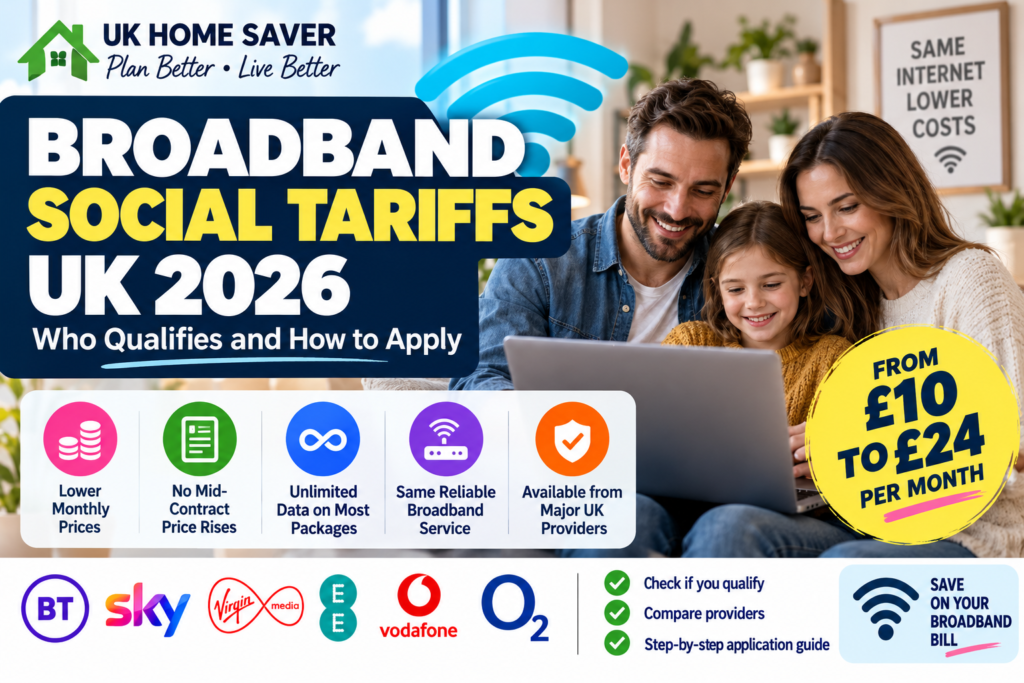
This guide explains how broadband social tariffs work, who may qualify, what they cost and how to apply.
What Is a Broadband Social Tariff?
A social tariff is a discounted broadband or mobile package aimed at customers receiving certain benefits or living on a low income.
Providers may use different names for them, including:
- Social tariff
- Essential broadband
- Basic broadband
- Home Essentials
- Essentials package
The service itself is generally delivered in the same way as a normal broadband package.
The main differences are usually the lower price and stronger protections against unexpected increases or exit fees.
Ofcom says more than 30 providers were offering social tariffs by February 2026.
Why Social Tariffs Can Be Worth Checking
A social tariff may offer several advantages over an ordinary broadband contract.
According to Ofcom, typical protections include:
- Lower monthly prices
- No mid-contract price rises
- Little or no setup cost
- No charge to switch onto your provider’s social tariff
- No early termination fee for leaving the social tariff
- Unlimited broadband on most packages
These protections can make household broadband costs more predictable.
Read:Free Boiler Grant UK 2026: ECO4 Eligibility and How to Apply
Who Can Qualify for a Broadband Social Tariff?
Eligibility depends on the provider.
However, Universal Credit is the most widely accepted qualifying benefit.
Ofcom states that if you or someone in your household receives Universal Credit, you may be able to access any of the social tariffs on its current list.
Major providers also commonly accept benefits including:
- Pension Credit
- Income-related Employment and Support Allowance
- Income-based Jobseeker’s Allowance
- Income Support
Some providers accept additional benefits, such as:
- Personal Independence Payment
- Attendance Allowance
The exact list differs between providers, so receiving one benefit does not automatically mean you qualify for every social tariff.
Does the Person Receiving the Benefit Need to Be the Account Holder?
Usually, yes.
Ofcom advises that the person receiving the qualifying benefit generally needs to be the main person named on the broadband contract.
If another person in your household currently holds the contract, ask the provider whether the account needs to be transferred before applying.
Do not cancel an existing broadband contract until you understand what the provider requires.
How Much Do Broadband Social Tariffs Cost in 2026?
Ofcom’s social tariff information, last updated in October 2026, says current broadband and phone social tariffs range from approximately £10 to £24 per month.
Prices, speeds and eligibility rules vary significantly.
For example, some current provider offers include:
| Provider/package | Current price | Example speed |
|---|---|---|
| Virgin Media Essential Broadband | £12.50/month | 15 Mbps |
| Virgin Media Essential Broadband Plus | £20/month | 54 Mbps |
| Sky Broadband Basics | £20 or £24/month depending on service | Varies by connection |
| BT Home Essentials Fibre 2 | £24/month | 67 Mbps |
Virgin Media currently offers its Essential packages on rolling 30-day contracts, while Sky’s Broadband Basics uses a 24-month arrangement but does not charge early termination fees if an eligible customer needs to leave. BT also offers several Home Essentials options. Virgin Media
Prices and packages can change, so always check the provider’s current terms before applying.
Which Providers Offer Social Tariffs?
The market is broader than many people realise.
Current social tariff providers listed by Ofcom include national companies and smaller regional networks.
Examples include:
- BT
- EE
- Sky
- Virgin Media
- Vodafone
- Hyperoptic
- Community Fibre
- Fibrus
- YouFibre
- NOW Broadband
- SMARTY
- O2
- VOXI
Availability may depend on where you live because some fibre providers only operate in certain areas.
Ofcom maintains a current list of social tariffs, prices, speeds and coverage areas.
Do You Have to Stay With Your Current Broadband Provider?
No.
Start by checking whether your existing provider offers a social tariff.
If it does, moving onto that package may be the simplest option.
If your provider does not offer a suitable tariff, you can look at other providers available at your address.
However, if you are still inside the minimum term of your current standard contract, check whether leaving would normally involve an early termination charge.
Ofcom says providers may sometimes allow customers to leave in order to move to a social tariff, but you should confirm this before switching.
How to Apply for a Broadband Social Tariff
The process is usually straightforward.
1. Check Which Benefits You Receive
Make a note of the benefit that may qualify you.
For example:
- Universal Credit
- Pension Credit
- Income Support
- Income-based JSA
- Income-related ESA
If you receive PIP or Attendance Allowance, check individual providers because eligibility is less consistent.
2. Check Your Current Provider
Search your provider’s website for:
social tariff
essential broadband
or
basic broadband
You can also contact customer services and ask directly whether they offer a discounted tariff for customers receiving benefits.
3. Compare Other Available Providers
Do not assume your current provider automatically offers the best option.
Compare:
- Monthly price
- Broadband speed
- Contract length
- Setup fees
- Landline requirements
- Availability at your address
- What happens when eligibility ends
Ofcom’s broadband checker can help you see which networks are available where you live. www.ofcom.org.uk
4. Complete the Eligibility Check
Providers normally need to verify that you receive a qualifying benefit.
The exact process varies.
You may be asked for information such as:
- Your name
- Address
- Date of birth
- National Insurance number
- Permission for an eligibility check
For example, Virgin Media says it can check qualifying benefits with the Department for Work and Pensions when the customer gives permission.
5. Read the Terms Before Switching
Check:
- The exact monthly price
- Broadband speed
- Contract length
- Whether there are setup charges
- Whether landline calls cost extra
- What happens when the social tariff ends
- Whether you need to reapply later
Do not assume every social tariff has identical terms.
Can Existing Customers Get a Social Tariff?
Often, yes.
Social tariffs are not necessarily limited to new customers.
If your current provider offers one and you become eligible, you may be able to switch from your ordinary package onto its social tariff.
Ofcom says customers should generally be able to move onto their provider’s own social tariff without paying a switching fee.
Contact your provider rather than cancelling your service yourself.
Will the Price Increase During the Contract?
One of the important features of social tariffs is price stability.
Ofcom says social tariffs should not have mid-contract price rises.
That can make them easier to budget for than some ordinary broadband contracts.
However, you should still check what happens when the agreed social tariff period ends.
Some providers may require you to reapply or move onto another package.
Are Social Tariffs Slow?
Not necessarily.
Ofcom says most current social tariffs offer superfast broadband above 30 Mbit/s.
Whether that is sufficient depends on your household.
A household using broadband mainly for:
- Browsing
- Online shopping
- Video calls
- HD streaming
may find a modest package perfectly adequate.
A household with several people simultaneously gaming, downloading large files or streaming high-resolution video may benefit from a faster package.
Do not pay for speed you do not actually need.
Can You Get a Social Tariff for Mobile Phone Service?
Yes.
Some providers offer mobile social tariffs as well as broadband packages.
Ofcom’s current list includes mobile offers such as O2 Essential Plan, SMARTY Social Tariff and VOXI For Now.
Social mobile tariffs can be worth checking if your mobile bill is also putting pressure on your household budget.
Read:How to Work Out the True Monthly Cost of Annual Bills
What If You Are Struggling but Do Not Qualify?
Contact your provider before missing payments if possible.
Providers may have other support available even if you do not meet the criteria for a formal social tariff.
You can also review whether you are paying for services you do not need.
Ofcom recommends checking:
- Whether you are still in contract
- Whether you could switch providers
- Whether you are paying for unnecessary speed
- Whether bundled services still offer value
- Whether SIM-only mobile could reduce costs
- Whether unused subscriptions can be cancelled
Check Whether You Are Out of Contract
This is worth doing even if you do not qualify for a social tariff.
Customers who have reached the end of their minimum contract may be able to find a cheaper broadband deal elsewhere.
Ofcom reported in September 2026 that around 3.5 million people had switched their landline or broadband provider over the previous two years, and said many out-of-contract customers could potentially save more than £100 by switching.
Compare the total contract cost, not just the introductory monthly price.
Be Careful With Broadband Deals That Look Too Cheap
Before changing providers, check:
- Whether the advertised price later increases
- Setup or activation fees
- Router charges
- Contract length
- Minimum guaranteed speed
- Landline costs
- Exit charges
- Whether the price depends on taking other services
A low headline price does not always mean the lowest overall cost.
Social tariffs are particularly useful because they tend to have simpler consumer protections.
Frequently Asked Questions
What is a broadband social tariff?
It is a discounted broadband or mobile package designed mainly for households receiving certain benefits or living on low incomes.
Can I get cheap broadband if I receive Universal Credit?
Potentially, yes. Universal Credit is accepted by the social tariffs currently listed by Ofcom.
Does Pension Credit qualify for cheaper broadband?
Many major providers accept Pension Credit as a qualifying benefit. Check the exact provider’s current eligibility rules before applying.
Can people receiving PIP get a social tariff?
Some providers accept Personal Independence Payment, but not all do. Eligibility varies by provider.
Will a social tariff affect my broadband quality?
It is still a normal broadband service, although the package may have a different advertised speed from the provider’s standard commercial plans.
Can I leave a social tariff without a penalty?
Ofcom says social tariffs should generally allow customers to leave without an early termination fee.
Are social tariffs automatically given to people on benefits?
No. You normally need to contact a provider and apply.
Final Checklist
Before applying for a broadband social tariff:
- Check which benefits you receive
- Check whether the broadband account is in the qualifying person’s name
- Ask your current provider about social tariffs
- Compare other providers available at your address
- Compare price and speed
- Check contract length
- Check setup costs
- Ask what happens when the social tariff period ends
- Confirm eligibility before cancelling an existing contract
- Review your broadband costs regularly
For an eligible household, a social tariff can be one of the simplest ways to reduce an essential monthly bill.
The important point is to check rather than assume. Providers use different names and eligibility rules, so compare current options using Ofcom and the provider’s own website before making a decision.
Optional UK Home Saver tool
If you are reviewing broadband alongside your other recurring household costs, the UK Home Saver Household Bills Command Centre can help you keep bills, subscriptions, payment dates, spending and savings together in one workbook.
View the Household Bills Command Centre on Gumroad
Also available from the UKHomeSaver Etsy shop.
This is an optional UK Home Saver digital product. UK Home Saver is not affiliated with Ofcom or any broadband provider mentioned in this guide.
[…] Read:Broadband Social Tariffs UK 2026: Who Qualifies and How to Apply […]