On Wednesday 28 October 2026, Chancellor John Healey delivered the Autumn Budget, titled “Breathing Space now, Hope for the Future”. It extends two cost-of-living measures and announces a major change to how gas bills are charged. This guide explains what the Budget means for your household bills, why it matters in England, Scotland and Wales, and what to check on your bill.
The scientific and policy details draw on guidance from the 【entity-UK Government¦canonical_name=UK Government】, the House of Commons Library, and Ofgem.
Why Does Autumn Budget 2026 Matter for Your Energy Bill?
What is the £100 Household Energy Payment?
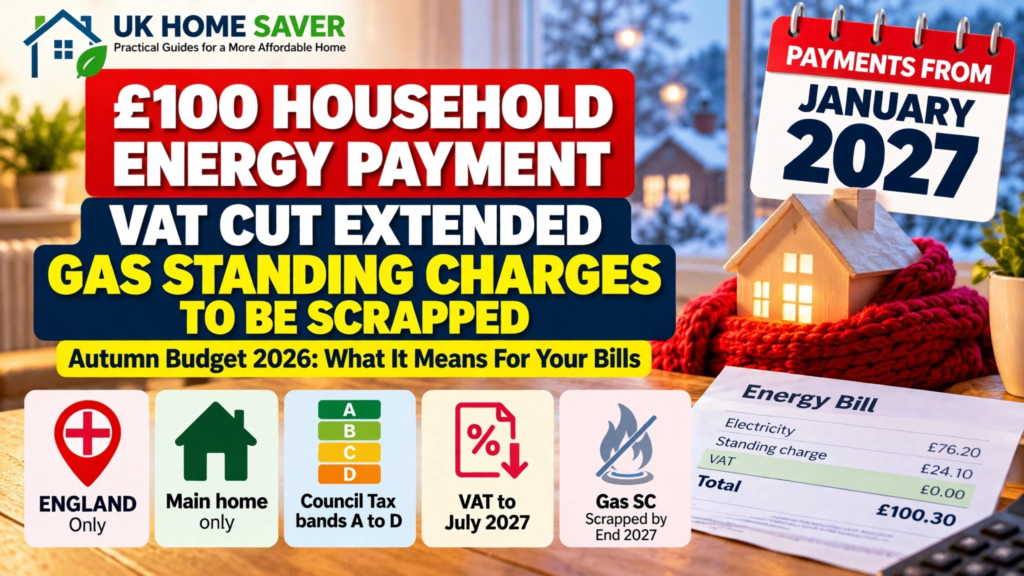
The £100 Household Energy Payment is a one-off payment to help millions of households with rising energy costs. Under the scheme announced in the Autumn Budget on 28 October 2026, households in England living in a main home in Council Tax bands A to D will be able to receive £100 from January 2027.
The government says the scheme will support up to 20 million households, cost around £2.6 billion, and reach 83% of fuel-stressed households in England. Most eligible households that pay Council Tax by Direct Debit should receive the money automatically. For full eligibility rules, see our guide on £100 Household Energy Payment 2027: Who Gets It.
How does the electricity VAT cut work? Four simple steps
1. Government sets temporary zero rate. From 1 October 2026, qualifying domestic electricity in England, Scotland and Wales is charged at 0% VAT instead of 5%.
2. Supplier applies it automatically. You do not need to apply. Your supplier should apply the correct VAT treatment to qualifying electricity supplied during the period.
3. Ofgem cap already includes it. The current price cap of £1,723 a year for a typical dual-fuel Direct Debit household already reflects 0% VAT on electricity. That is why you should not subtract another 5% from the published rate.
4. Extension to July 2027 saves more. The Budget extends the zero rate from 31 March 2027 to 1 July 2027. Without the extension, the April 2027 cap would be around £50 higher. For details on current rates, see our guide on Electricity VAT Cut: What 0% Means for Your Bill.
Why are gas standing charges being scrapped?
Gas standing charges are the fixed daily fee you pay even if you use no gas — currently 29.68p per day or around £108 a year. The Budget says Ofgem has been asked to remove standing charges on household gas bills by the end of 2027 or as soon as possible after that.
This is part of a wider review of standing charges. Electricity standing charges will remain for now, but gas removal would particularly help low gas users and second homes that still pay daily charges while empty. Our guide on Standing Charges October 2026: Why You Pay £120 First explains why you pay £120 a year before using energy.
What Are the Three Energy Measures Side by Side?
| Measure | What it is | Who benefits | Everyday example |
|---|---|---|---|
| £100 Payment | One-off £100 from council, from Jan 2027 | England, Bands A-D, main home | £100 in bank, not off energy bill |
| Electricity VAT 0% | VAT removed on domestic electricity | GB (England, Scotland, Wales) | Saves ~£45 a year vs 5% VAT |
| Gas Standing Charge Removal | Fixed daily gas fee to be removed | All GB gas customers (from end 2027) | Saves ~£108 a year if removed |
| Fuel Duty 5p Cut | Temporary 5p cut extended | Drivers UK-wide | Keeps petrol price lower until July 2027 |
The House of Commons Library distinguishes these measures in its Autumn Budget 2026 summary. They are related but not identical.
How Can You Get £100 When Council Tax Says Band D?
Council Tax bands are based on property value in 1991, not your income. Band D is included in the standard A-D range. If your main home is in England and in band A, B, C or D and you are liable for Council Tax, you appear to be within the main group. Final eligibility will still depend on detailed rules when published.
Band E-H households are not part of the standard scheme, but an extra £100 million discretionary fund for English councils may help some struggling households outside A-D. Each council will set its own criteria. If you rent, the key question is whether you are responsible for Council Tax — see our £100 checker guide for renters and HMOs.
Why Does Your Bill Still Say £1,723 After Budget?
The headline Ofgem cap of £1,723 is based on typical usage and already includes 0% VAT on electricity. Your actual bill depends on how much gas and electricity you use, where you live, payment method and tariff. The Budget extension prevents the cap from rising by ~£50 in April 2027, but does not cut the current £1,723 figure itself.
A household using more energy than typical can still pay more than £1,723. A low-use household may pay less. For appliance costs that push bills up, see our guide on How Much Appliances Cost to Run and 5 Fridge Freezer Faults That Spike Your Bill After £1,723 Cap.
Can You Get £100 and Warm Home Discount?
Yes. The £100 Household Energy Payment is separate from the Warm Home Discount £150. The Warm Home Discount has its own eligibility based on means-tested benefits and property characteristics. A household that meets both may get £250 total support this winter (£100 + £150). See our guide on Warm Home Discount October 2026: Who Gets £150 Automatically.
Three Simple Checks You Can Make This Week
1. Check Council Tax band: Use the official GOV.UK service to check your band. Do not pay a company to check it.
2. Check VAT on bill: Look at electricity section — from October 2026 it should show 0% VAT in GB. Gas still shows 5% VAT.
3. Check standing charge: Find gas standing charge — currently 29.68p/day. It will remain until Ofgem removes it, expected end of 2027.
These checks reveal that Budget help is about timing and eligibility, not just a single number on your bill.
Frequently Asked Questions
When was Autumn Budget 2026?
28 October 2026, delivered by Chancellor John Healey. Prime Minister Andy Burnham. Supporting documents published on GOV.UK Autumn Budget 2026.
Who gets the £100 payment?
Standard scheme: England, main home, Council Tax bands A-D, liable for Council Tax. Most Council Tax exempt households expected to be included. Second homes and empty properties not eligible.
Is electricity VAT really 0% until July 2027?
Yes. The Budget extends zero rate on qualifying domestic electricity in Great Britain from 1 October 2026 to 1 July 2027. It was previously due to end 31 March 2027.
Will gas standing charges disappear?
Government asked Ofgem to remove domestic gas standing charges by end of 2027 or as soon as possible after. Not yet law — Ofgem must consult. Electricity standing charges remain.
Does Scotland, Wales, Northern Ireland get £100?
Standard £100 applies to England. Additional funding provided to devolved governments to provide similar support. Separate announcements expected.
Can I get £100 and £150 Warm Home Discount?
Yes, they are separate schemes with different rules. Meeting both means you can benefit from both.
What if I don’t pay Council Tax by Direct Debit?
Council expected to invite eligible non-Direct Debit households to apply directly. Wait for council invitation, do not give bank details to random sites.
The Bottom Line
Autumn Budget 2026 provides breathing space but not a bill freeze. The £100 payment helps from January 2027, the electricity VAT cut saves around £45 a year and now lasts until July 2027, and gas standing charges may be removed by end of 2027. Together they offset some pressure from Ofgem’s £1,723 cap and forecast inflation of 3.8% in early 2027.
Understanding the difference between a Council Tax based payment, a VAT cut already in your cap, and a future standing charge removal helps explain why British households see different amounts at different times this winter.
Sources and further reading: House of Commons Library: Autumn Budget 2026 summary CBP-12252; UK Government: Autumn Budget 2026 documents on GOV.UK; Ofgem: Energy price cap unit rates; Grant Thornton: Autumn Budget 2026 what you need to know.