Updated: 25 October 2026
Keeping your home warm through a UK winter can take a significant share of the household energy budget. But cutting heating costs does not have to mean sitting in an uncomfortably cold home.
The better approach is to reduce wasted heat: use your heating controls properly, stop unnecessary draughts, avoid overheating rooms that do not need it and make sure your boiler or heating system is set up sensibly.
Heating and hot water make up a large proportion of household energy use, so relatively small improvements can add up over the colder months. This guide explains practical ways to reduce heating costs while keeping comfort and health in mind.
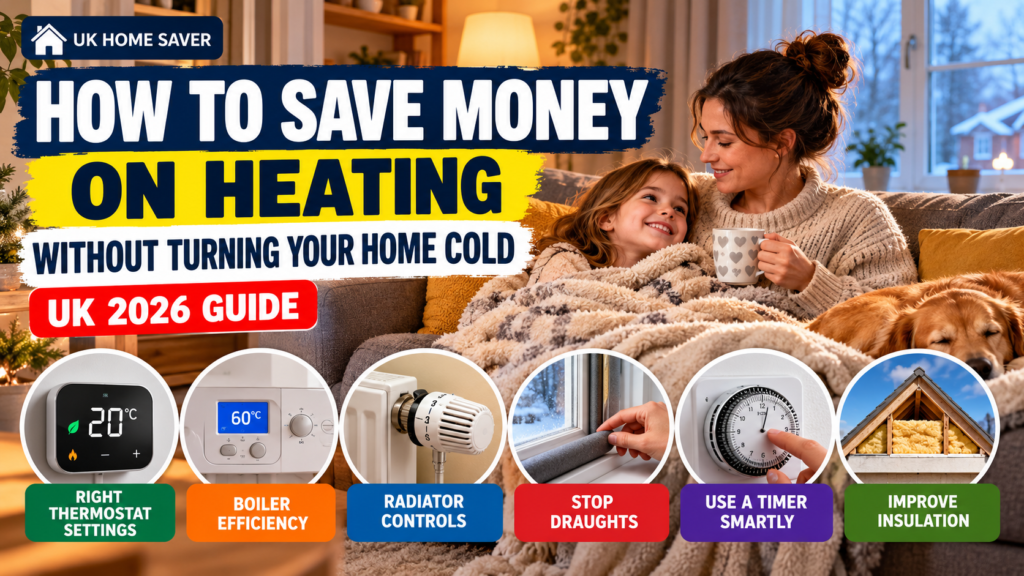
Do Not Make Your Home Dangerously Cold
Saving money matters, but health comes first. NHS guidance says you should heat your home to a temperature that is comfortable for you and, if you can, keep rooms you regularly use at at least 18°C.
This is especially important if somebody in the household is older, has a long-term health condition or is otherwise more vulnerable to cold weather.
The aim is not to see how cold you can tolerate your home. It is to keep the warmth you need while reducing heat that is being wasted.
1. Use the Lowest Comfortable Thermostat Setting
For many people, a comfortable thermostat setting is somewhere between 18°C and 21°C.
If your thermostat is set higher than you need, reducing it slightly can lower heating use. Energy Saving Trust currently estimates that reducing a thermostat from 22°C to 21°C could save around £120 a year in Great Britain.
That figure is an estimate rather than a guaranteed saving. Your own result will depend on the size of your home, insulation, heating system, tariff, weather and how long the heating is normally on.
2. Do Not Turn the Thermostat Much Higher to Heat the Home Faster
If your thermostat is set to 20°C, turning it to 25°C does not normally make the home warm up faster. It tells the heating system to continue operating until the higher temperature is reached.
On a particularly cold morning, the home may simply take longer to reach the temperature you want.
It is usually better to use the timer or programmer properly than to keep increasing the target temperature.
3. Review Your Heating Timer
A timer or programmer lets you control when central heating comes on and switches off.
Check whether your current schedule still matches your household routine. You may be heating the property:
- Long before anybody wakes up
- After everybody has left for work or school
- For long periods while the home is empty
- Late at night when nobody needs the rooms as warm
Adjusting unnecessary heating periods can reduce energy use without making occupied rooms colder when you actually need them.
4. Use Thermostatic Radiator Valves Room by Room
If your radiators have thermostatic radiator valves, or TRVs, they allow you to control individual rooms.
You might choose a warmer setting in the living room, a comfortable setting in the main bedroom and a lower setting in a spare room that is rarely used.
Use the lowest setting that keeps each occupied room comfortable. The numbers on TRVs are not exact universal temperature measurements, so adjust them gradually rather than assuming that the same number produces the same room temperature on every system.
5. Turn Radiators Down in Less-Used Rooms Rather Than Automatically Switching Them Off
Reducing heat in rooms you rarely use can save energy, but leaving rooms completely unheated for long periods during cold weather can contribute to condensation, damp and mould.
Current government energy-saving guidance recommends turning radiators down rather than necessarily turning them completely off in rooms you are not using much.
The correct setting depends on your property and the people living in it.
6. Check the Flow Temperature on a Combi Boiler
Your boiler’s flow temperature is the temperature of the water sent from the boiler through the radiators.
Many modern combi boilers are set higher than necessary. UK government energy-saving guidance suggests reducing the central-heating flow temperature on many combi boilers to around 60°C so the boiler can operate more efficiently.
Do not apply this advice blindly to every heating system.
If you have a regular or system boiler with a separate hot-water cylinder, the requirements are different because stored hot water must reach a safe temperature. If you are unsure which type of boiler you have, check the manufacturer’s instructions or ask a qualified heating engineer before changing settings.
7. Bleed a Radiator That Is Cold at the Top
If a radiator is warm at the bottom but noticeably cold at the top, trapped air may be preventing hot water from circulating properly.
Bleeding the radiator can release this air. Follow the instructions for your heating system and take care around hot water and hot surfaces.
If the whole radiator is cold, the problem may be a control setting, valve or another heating-system issue rather than trapped air.
8. Give Radiators Space to Work
Large furniture placed directly in front of a radiator can prevent heat from circulating effectively through the room.
Where practical, avoid placing sofas, cabinets or other bulky furniture directly against radiators. Long curtains should also not cover a radiator while the heating is on.
The aim is to allow warm air to move into the room rather than trapping it behind furniture or between a curtain and the window.
9. Close Curtains and Blinds After Dark
Windows are an important route for heat loss.
During daylight hours, opening curtains can allow sunlight into the home. When it gets dark, closing curtains or blinds can help reduce heat loss through the glass.
Heavy or thermally lined curtains can be useful around draughtier windows, but make sure they do not hang over radiators.
10. Find and Fix Obvious Draughts
Common draught locations include:
- External doors
- Window frames
- Letterboxes
- Gaps around floors and skirting boards
- Gaps around pipework
- Unused chimneys
Energy Saving Trust currently estimates that suitable draught proofing around windows, floors and doors could save around £55 a year in Great Britain.
DIY draught strips and door excluders can be relatively inexpensive, but do not block ventilation that is there for safety or moisture control.
Do not seal essential ventilation
Do not block air bricks, extractor-fan openings or other ventilation required for your home or appliances. A property still needs controlled ventilation to manage moisture and indoor air quality.
11. Consider Radiator Reflector Panels on Suitable External Walls
Reflector panels sit behind a radiator and reduce some of the heat being absorbed by the wall behind it.
They are most useful behind radiators mounted on uninsulated external walls.
Energy Saving Trust currently estimates that suitable radiator reflector panels could save around £18 a year in Great Britain.
This is a relatively small saving on its own, but it can form part of a group of low-cost improvements.
12. Keep Internal Doors Closed Where It Helps
If you are trying to keep particular occupied rooms comfortable, closing internal doors can reduce the movement of warm air into colder hallways and little-used rooms.
This can be especially useful in older or draughtier properties.
Continue to use appropriate ventilation in kitchens, bathrooms and other areas where moisture builds up.
13. Check Hot-Water Cylinder Insulation
If your home has a hot-water cylinder, check whether it is properly insulated.
Energy Saving Trust says cylinder insulation should be around 80mm thick. It currently estimates that adding a British Standard jacket to a cylinder with only around 25mm of insulation could save about £45 a year in Great Britain.
Follow the product instructions carefully and do not cover components that must remain accessible or ventilated.
14. Insulate Accessible Hot-Water Pipes
Pipe insulation can reduce heat loss from accessible hot-water pipes and can help protect some pipework during cold weather.
Foam pipe insulation is inexpensive and can be fitted to suitable accessible pipes if you are confident with basic DIY.
Do not interfere with boiler components or other equipment that should be handled by a professional.
15. Never Use an Oven or Gas Hob to Heat the Home
An oven or gas hob should never be used as a substitute for proper room heating.
Combustion appliances can create serious safety risks if they are used incorrectly or ventilation is inadequate. Use cooking appliances only for their intended purpose.
16. Use Portable Electric Heaters Carefully
A portable electric heater can be useful for short periods in one occupied room, but it is not automatically cheaper than central heating.
The running cost depends on the heater’s power rating, your electricity tariff and how long it is operating.
For example, a 2kW heater uses about 2kWh of electricity for every hour it runs continuously at full power.
Keep portable heaters away from curtains, bedding, furniture and other combustible materials, and follow the manufacturer’s safety instructions.
17. Do Not Assume Leaving a Gas Boiler Heating System On All Day Is Cheaper
For homes heated by a conventional boiler, keeping the heating on continuously generally uses more energy because the building continues losing heat while you maintain the indoor temperature.
Energy Saving Trust advises using the heating when you need it rather than leaving a boiler-based system on all day.
Heat pumps are different. They often work most efficiently with steadier operating patterns, so follow the manufacturer’s or installer’s instructions if your home uses a heat pump.
18. Check Your Loft Insulation
If your home loses heat quickly, control settings can only solve part of the problem.
Insulation reduces the rate at which heat escapes. Check whether loft insulation is thin, patchy or missing and consider professional advice if you are unsure what is appropriate for the property.
Depending on your home, other improvements may include cavity-wall insulation, solid-wall insulation, floor insulation or improved glazing.
19. Check Whether You Qualify for Energy Support
Reducing energy use is only one part of managing winter heating costs. Some households may also qualify for financial support or energy-efficiency assistance.
One current scheme is the Warm Home Discount, which provides eligible households with a £150 energy-bill discount.
See our full guide: Warm Home Discount October 2026: Who Gets £150 Automatically?
If somebody contacts you unexpectedly offering guaranteed government-funded heating work, check the scheme and the company independently before agreeing to anything or handing over personal information.
20. Track Heating Costs Instead of Guessing
It is difficult to know whether a change has helped if you never record your energy bills or meter readings.
Try keeping a simple record of:
- Monthly gas use
- Monthly electricity use
- Meter readings
- Actual bill amount
- Thermostat settings
- Major changes in household routine
Weather changes from month to month, so comparisons will never be perfect, but a record can still help you identify larger trends.
If you want to organise your regular and irregular household costs together, see our guide on how to organise household bills.
21. Include Energy Costs in Your Real Monthly Household Budget
Energy bills may be higher in winter and lower in summer, so looking at one month in isolation can give a misleading picture of your overall household costs.
It can help to convert annual or irregular expenses into monthly equivalents and keep them alongside your normal Direct Debits.
Our guide to working out the true monthly cost of annual bills explains a simple way to do this.
Which Heating Changes Should You Try First?
If you want to begin without spending much money, start with the basics:
- Check your thermostat setting.
- Review your heating timer.
- Adjust radiator valves room by room.
- Move furniture away from radiators where practical.
- Close curtains and blinds after dark.
- Find obvious draughts.
- Check boiler settings only if you understand your system.
- Bleed radiators that genuinely contain trapped air.
- Check hot-water cylinder and accessible pipe insulation.
- Investigate larger insulation improvements if your home loses heat quickly.
This order focuses on reducing obvious waste before spending significant money on new equipment.
How Much Could You Save?
There is no single honest figure that applies to every household.
Current Energy Saving Trust examples for Great Britain include:
- About £120 a year from reducing a thermostat from 22°C to 21°C
- Around £55 a year from suitable draught proofing around windows, floors and doors
- Around £18 a year from radiator reflector panels in appropriate locations
- Around £45 a year from improving insulation on a poorly insulated hot-water cylinder
These figures should not simply be added together and treated as a guaranteed total saving. Measures interact with one another and actual results depend on the property, existing efficiency, household behaviour, energy prices and weather.
Optional UK Home Saver Tool
If you prefer to track energy costs alongside household bills, annual expenses, subscriptions and savings, the UK Home Saver Household Bills Command Centre is an optional spreadsheet system designed for this purpose.
You can browse UK Home Saver digital tools through the UKHomeSaver Etsy shop.
You do not need to buy anything to use the heating-saving methods in this guide.
Frequently Asked Questions
What temperature should I set my thermostat to in winter?
For many people, the lowest comfortable setting is between 18°C and 21°C. NHS guidance says regularly used rooms should, if possible, be at least 18°C, particularly where health conditions make cold weather more risky.
Does turning the thermostat higher heat the house faster?
Usually no. A higher thermostat setting generally makes the heating stay on until the higher target temperature is reached rather than making the property warm up faster.
Should I turn radiators off in rooms I do not use?
Turning a TRV down can reduce energy use, but leaving a room completely cold for long periods can contribute to damp and mould. Government guidance recommends turning radiators down rather than automatically switching them completely off in less-used rooms.
Should I set my combi boiler flow temperature to 60°C?
Government energy-saving guidance suggests around 60°C for the central-heating flow temperature on many combi boilers. This should not automatically be applied to systems with a separate hot-water cylinder. Check your boiler type and manufacturer instructions before changing settings.
Is it cheaper to leave the heating on all day?
For conventional boiler heating, generally no. Keeping the property warm continuously means replacing heat that escapes throughout the day. Heat pumps operate differently and may benefit from steadier settings.
Are electric heaters cheaper than central heating?
Not automatically. A portable electric heater may make sense for a short period in one room, but its running cost depends on its power rating, your electricity tariff and how it compares with the alternative heating system.
Do radiator reflector panels work?
They can reduce heat loss through the wall behind a radiator, particularly on uninsulated external walls. The saving is usually modest rather than dramatic.
Can closing curtains help reduce heating costs?
Closing curtains or blinds after dark can reduce heat loss through windows. Avoid letting curtains cover a radiator because this can trap heat in the wrong place.
What should I do if I cannot afford to keep my home warm?
Do not simply stop heating your home if doing so could put your health at risk. Check current benefit entitlement, energy-bill support, supplier assistance and local or national energy-efficiency schemes.
Final Heating-Savings Checklist
- Keep regularly used rooms at a safe and comfortable temperature.
- Check whether your thermostat is set higher than necessary.
- Use your timer around your real household routine.
- Adjust radiator valves individually.
- Turn heating down rather than automatically leaving little-used rooms completely cold.
- Keep furniture and curtains from blocking radiators.
- Close curtains and blinds after dark.
- Draught proof suitable windows and doors.
- Do not block essential ventilation.
- Check whether radiator reflector panels are appropriate.
- Check hot-water cylinder insulation.
- Understand your boiler type before changing flow temperatures.
- Consider insulation if your home loses heat quickly.
- Check current energy support before paying for major improvements.
- Record energy costs so you can see whether changes actually help.
Saving money on heating is not about seeing how cold you can tolerate your home.
The better strategy is to keep the warmth you need while reducing the heat you waste. Start with the controls you already have, tackle obvious draughts, allow radiators to work properly and then consider larger improvements if they make sense for your property.
Sources and Further Guidance
- Energy Saving Trust: using central heating controls efficiently
- Energy Saving Trust: draught proofing
- NHS: keep warm, keep well
- UK Government: save energy in your home
UK Home Saver provides general household-cost information. Energy-saving estimates are illustrative and are not guaranteed. If somebody in your household is vulnerable to cold or has a health condition, health and comfort should take priority over reducing energy use.